
Examples of Early Estonian Computer Art
More is documented about early Estonian computer art from the mid-1990s, when many artists began to use digital tools in their work. The years 1996–1997 were a turning point, when many artists creating art with the help of computers entered the scene. In 1997 Raivo Kelomees, Tiia Johannson and Nelli Rohtvee completed “Cybertower”, net art was gathering momentum and Mare Tralla started out as a net artist. This is a subject that art critics have already commented on quite a lot and discussed widely. But what happened before that? How did artists find their way to the computer, how did they relate to it in their work, and what technologies did they invent?
This article looks at computer art in the context of the various phenomena that influenced it. The result is a somewhat patchy, but certainly colourful picture of the situation from which today’s Estonian digital art is already breaking away – detached from it, yet at the same time compiled out of it. On its path of development, early computer art was connected with visuals produced by computer for scientific purposes. At the same time, the birth of Estonian digital art was also influenced by the subculture of schoolboy hackers and the game programming that spread in the late 1980s. As the origins of computer-generated visual output in these fields have not been discussed in any detail in Estonia, these connections remain relatively invisible for lack of a thorough overview – but they exist nonetheless. On top of all this, early computer art was subject to strong and shifting political, economic and value-related factors. In the Soviet Union, the development of computing technology – first and foremost a military technology – was shaped by the Cold War and by the shadow of the Iron Curtain. The history of Soviet computing and the political decisions concerning it undoubtedly also affected developments in Estonia.
The story of early Estonian computer art can be traced back to the 1960s, when a number of interesting visuals were created with the help of computers. In 1959, when Estonia’s first electronic computer, the URAL-1, arrived in Tartu, Estonia’s first computing centre – that of the University of Tartu – was launched. [1] With the emergence of computing centres, access to the tools and resources for making computer art also became possible. Professor emeritus Leo Võhandu draws a strict distinction between computing stations, which were subordinate to the Statistical Administration of the Estonian SSR, and computing centres, which were attached to universities and other institutions. [2] The more interesting activity, however, took place at the computing centres, since the computing stations were occupied with collecting and processing statistical data, and it was relatively difficult for outsiders to gain access to their computers. During the computing-centre period, mainly in the 1970s, so-called picture programs spread, which printed pictures made of characters. Most of the first printed pictures had been produced elsewhere. Rolls of paper with printed pictures of unknown origin and authorship often hung on the walls of computing centres. Most of these anonymous picture programs probably came from Russia, brought back from work trips. Usually ready-made pictures obtained from elsewhere were circulated, or random drawings or photos were converted into ASCII form. A picture made of characters was a high-tech achievement of sorts at the time. One of the first widely circulated picture programs printed a picture of Mickey Mouse. Other popular motifs people remember are female nudes, the Mona Lisa, a portrait of Albert Einstein and gnomes. There was even a panorama of Tallinn in circulation that was up to a metre wide. Märt Orgussaar’s “Eva” (1968) has survived: printed in characters at a length of more than a metre, it depicts a lady in a bikini. There were curiosities, too: when Johannes Käbin, First Secretary of the Central Committee of the Communist Party of Estonia, visited the Estonian Radio computing centre in the 1970s, the staff there printed out a portrait of their guest made of characters. [3] What do these symbols carry within them? New output devices with new possibilities evidently inspire people to use them straight away. The attempts, mostly by non-artists, to get ever more powerful (audio)visual output from the computer occupy above all the position of a preparatory phenomenon. In the early 1960s, for example, Heiki Sumre, an engineer at the Institute of Cybernetics, demonstrated electronic output to school excursion groups with the program “Kiisu” [Kitty], which drew an image of a cat on an oscilloscope screen; for the same institute’s M-3 mainframe, a computer game called “Tikumäng” [The Matchstick Game] was written, to be played between two people or between a computer and a person. But all these programs were created half in jest, perhaps really more for the school groups visiting the computing centre. In the early days, computers were generally used for specific purposes in very limited fields and by a narrow circle of specialists. Ordinary people had no access to computers, let alone the skills to do anything with them. Records have survived of attractive visuals created with computers for scientific purposes in research institutions. Visualisations of scientific data can serve as illustrations of the kind of visual output it was possible to get from computers. So these solutions could have been used by artists, too. A graphical user environment created in the 1980s for the Institute of Cybernetics’ speech synthesiser is said to have looked interesting. The curves of the speech synthesis control parameters were displayed on the computer screen and could be moved with a mouse, and you could immediately hear how a change in a parameter affected the quality of the synthesised sound or the prosody of a word. [4] While working at the Institute of Physics in Tartu in 1990, Viljar Allsalu used a computer to produce images of objects in false colours (в искусственных цветах). This was work done for the USSR Institute of Atomic Energy. An object in a plasma state was photographed with equipment built on site and displayed on a colour television screen via an interface unit connected to an “SM-4” computer. Vello Reeben arrived at distinctive patterns in his scientific work. Using Daniel Bernoulli’s algorithm for finding the largest root of an algebraic equation of degree n, he wrote a program in Basic that generated drawings describing the forms of plants. At the same time, it would be naïve to think that artists in Soviet Estonia in the 1970s were unaware of the computer as a possible art technology. Artists had seen the visuals created by scientists in research institutions. The engineer Harry Tani remembers several conversations – which, admittedly, never went beyond discussion – in which he and an artist he was talking to considered the computer as an artistic medium. In addition, as early as 1973 Ustus Agur wrote about computer art in the magazine “Kunst ja Kodu” [Art and Home] under the title “Kunst elektronkonveierilt” [Art from the Electronic Conveyor Belt] [5], and in 1975 in “Horisont” about cybernetics and art [6], treating them as an entirely self-evident combination. In Soviet times, Estonian art life was generally closed off from the world beyond the borders of the Soviet Union. Foreign art magazines, which trickled in with difficulty but trickled in nonetheless, were one channel of information. The library of the Estonian Academy of Arts holds a 1972 issue of the magazine “Graphis” [7], which introduces computer graphics in depth.
There are also records of the first computer art exhibitions in Estonia. In 1980, when the President of the USSR Academy of Sciences visited the Institute of Physics of Tartu State University, an exhibition of computer-made pictures was organised there for the occasion. Interesting-looking plotter drawings were gathered together, and Professor Jaak Kikas gave them a uniform look with black passe-partouts. Alo Raidaru [8], then head of the Institute of Physics’ computer group and the organiser of the exhibition, recalls that it was perhaps visitors with some background in art who lingered longest in front of the exhibits. The monochrome plotter drawings resembled abstract compositions with a touch of op art. Among other things, there was a picture of a mathematical circular wave, a column striving towards infinity and a technical drawing of a printed circuit board. [9] Yet none of the works in the exhibition had been made as art – they were technical diagrams or illustrations explaining scientific results. But this exhibition was by no means the only precedent. Between 1969 and 1973, Enn Tõugu together with Ivar Papp organised an exhibition introducing computer graphics at the Tallinn House of Engineers, with exhibits taken from foreign magazines such as “Computers and Automation”. [10]
In art, elements of early multimedia can be found in the work of Leonhard Lapin: in his 1980 multimedia performance “Multipitseeritud inimene” [The Multiplied Man] at the Tallinn State Youth Theatre, he used television screens with flickering images and random snippets of broadcasts [11] as artistic material. [12] Lapin considers himself the first in Estonian art to use the television screen as an artistic material [13], but here it is worth recalling Heitti Polli’s manipulations of a television screen with a magnet in the 1970s [14]. Together with the electronics engineer Tiit Kralla, Heitti Polli developed a method in which a TV screen was influenced with a magnet and the resulting interesting combinations of colour were photographed onto slides. Heitti Polli then transferred the images captured on slides to large paintings, being among the first in Estonia to use an airbrush. In addition to the TV screen and the magnet, H. Polli and T. Kralla used all kinds of mechanical and optical props, such as mirrors, kaleidoscopes and magnifying glasses. There was constant movement in the magnetic field – the patches of colour shimmered and flickered, and the moment at which the image was captured on the slide played a part in the result. Video technology did not yet exist, colour photo enlargement was not yet technically available to artists, and slides themselves were difficult to show. These works could be called copies of electronic art executed in oils. Oil painting was in fact only one of the possible ways of transferring the image. Helgi Polli used the colour compositions of these same slides when making tapestries in her artprotis technique. Although by using the television screen these artists merely brushed against the technology of computer art, they were nevertheless engaged with its aesthetics.
The computer as a tool at the artist’s disposal
Computer technology has often been used for printing out – for making graphic works that can be exhibited on paper and as pictures. A number of artists have exploited the computer as a tool for achieving a mechanical or anonymous pattern. The computer was one stage in the art-making process, where a work was run through it as if through a matrix and then developed further using other, more handcrafted techniques. In its working principle, the computer was like a printing matrix.
In the late 1980s, Mall Nukke’s prints were created with the help of a computer at the Institute of Physics of the Academy of Sciences. When making repeated shapes, deforming them slightly each time, Nukke made use of the possibilities of the Paintbrush program. After printing out the images, she coloured them with coloured pencils and drew over them with a Rapidograph pen. According to the artist, the concept of these works was simply to achieve visual effects and mechanical textures. [15] The perforated paper strip, when displayed horizontally, favoured rows of composition read from left to right. Such experiments were practically non-existent in Estonian printmaking at the time. In general, printmakers’ first encounters with the computer mostly happened in design work rather than in making art. The computer also played a part in the technique of Nukke’s later “Ambroosia” [Ambrosia] series, created in 1992 as her diploma work at the art university. Sketches made in Paintbrush were printed out on a printer, and the images were transferred to paper by screen printing. In Nukke’s works, mechanically coarse pixel graphics are used as a motif, as a pattern, like the pine-tree figures in a mitten pattern. The shifts that occurred in the printing press sometimes make it impossible even to guess that Paintbrush was involved. The stepped, jagged edges are more reminiscent of a textile with a knitted-in pattern than of pixel graphics.
Acquaintances working at computing centres often played an important part in helping artists reach computer technology. Aavo Ermel’s path to the computer began thanks to Toomas Tiivel, who worked at the Institute of Biology of the Academy of Sciences and in 1987 showed the artist the computer’s mechanical drawing capabilities. At that time the Institute of Cybernetics had a computer called Lisa. Aavo Ermel got to know the Lisa: “I even had an Institute of Cybernetics staff pass.” [16] In 1988 an exhibition of Aavo Ermel’s prints was held at the Kunstihoone salon [the Tallinn Art Hall gallery], with works made on that same Apple Lisa. The computer was only one part of the production process, however: the drawings were made in the “MacPaint” program. Copies were made of the computer drawings printed on a dot matrix printer; these were photographed, and from the large-format films zinc plates were made at the “Kommunist” printing house. They were then printed onto paper at the printmaking studio on Vabaduse plats [Freedom Square]. Aavo Ermel’s minimalist prints have a sci-fi pixel-patterned surface that was unfamiliar for its time and that arouses interest through its technological origin. One meaning is created by the shape and another by the bustling optical movement formed in the pattern of that shape.
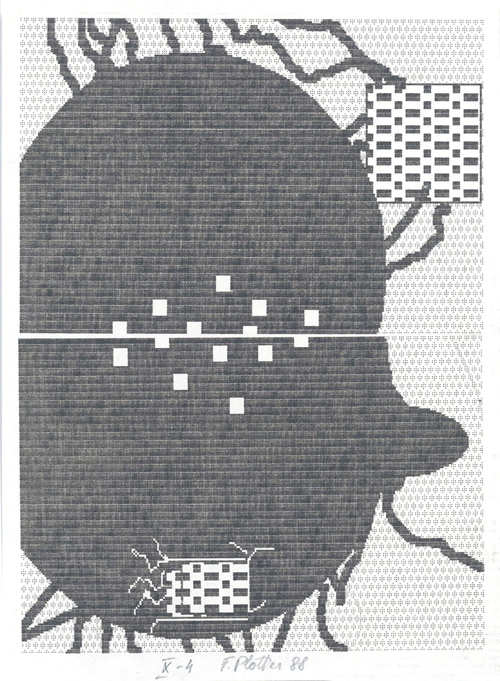
In the 1980s, an interesting interdisciplinary group was formed by three men from Pärnu working under the pseudonym “Fin Plotter”: the biophysicist Jüri Lilles, the hydrobiologist Jüri Tenson and the theatre designer Vello Tamm. The name Fin Plotter came from the tool used to draw the pictures – the plotter. Each print was based on a precisely configured Basic program on a “Tektronix” computer. At first the artists used a random number generator to create the pictures; later they began to give the program starting points themselves. Jüri Lilles did the programming, while the other members of the group suggested changes to the point coordinates. To get a more sensitive line and a finer structure, a Tintenpen was fitted in place of the plotter’s pen, and thin paper with a fibrous texture was used. The pictures were created as a kind of club activity at the field station of the Pärnu Institute of Ecology, where both biologists worked.
9_Custom
Elements of group work can also be found in the work of Studio 22. Like Fin Plotter’s works, the computer-based pieces “Varajane kevad” [Early Spring] (1993) and “Ruummeri” [Room Sea] (1995) by the artists’ group Studio 22 lend themselves to in-depth and very thorough analysis. The only question here is how deep the writer dares to descend – whether the well they are looking into seems frighteningly deep, or whether they see their own gaze reflected back at them in the water. The core programme of the Studio 22 movement had already taken shape in the 1970s. It was a school of thought gathered around Tõnis Vint, which drew impulses for its creative activity from ancient cultures and Far Eastern aesthetics. In this art movement, what came first was not the artwork as an object, but its creation and the spiritual opening that came through studying various Eastern teachings. These club-like gatherings have proved so significant that people list Tõnis Vint’s studio in their educational background as art education. Those who attended Tõnis Vint’s studio included Rainer Kurm, Jaak Saks and Martin Vällik. Their years-long tradition of meeting, along with their exchanges of ideas and discussions on deep philosophical themes, was the preparation for the installations “Varajane kevad” and “Ruummeri”.
The artists’ ideas for “Varajane kevad” took shape in several stages: the conceptual background that originated with Tõnis Vint, programming in Basic, colouring the pictures generated by the program, rendering a video from them in turn [17], planning the installation, and creating the space and the musical backdrop. “Varajane kevad” and “Ruummeri” are based on the number tables of personal oracles, from which various patterns were derived using mathematical methods. How a number table becomes a picture – that is the key, the most fundamental and important principle. Martin Vällik: “The primary task was not to make art at all, but to find an answer to the question of how to visualise the number tables of the I Ching [18]. Tõnis Vint had worked out this principle, but doing it by hand was quite gruelling.” [19] So Martin Vällik wrote a program that creates an initial black-and-white image from a number table, from which a kind of pattern can then be created by repeated mirroring. If you compare the number table with the image derived from it, you can see that each number position in the table corresponds to an 8×8 square in the same position in the image, and these squares are filled or left empty according to the number they represent. This pattern was loaded into computer memory, then opened in a graphics program, coloured, transformed in various ways and saved. This was one stage of the work, which yielded the initial visual material for the installation. In this way a sequence of different patterns was created, which were joined together in a video that was projected in the installation. Together with a mirror placed on the floor, which doubled the play of colours, the projection [20] formed a kind of kaleidoscope. Music composed by Jaak Saks on the basis of the I Ching was used as the soundtrack.
Making a work like this required a certain erudition from all members of the group and an interest in looking beyond everyday reality. Jaak Saks was responsible for the written interpretation and the philosophy of the art projects created through group work. A number of thoughts, observations, drawings and diagrams published by them have survived; studying them in depth would require a separate expertise. The installation presented at the exhibition “Aine-aineta” [Matter–Without Matter] was supported at the same time by Jaak Saks’s “public relations” explanatory work published in the weekly “Eesti Ekspress” [21], which was meant to explain seemingly esoteric knowledge to the general public. In his commentary on the exhibition, Peeter Linnap notes, among other things, “the ‘mixing up’ of theories and art and didactic programmes/pogroms”. [22] How did a work like this fit into the curatorial programme of “Aine-aineta” in 1993? Ando Keskküla, as the curator of the exhibition, explored the dematerialisation of art and the artist’s attitude to reality: “The content of ‘Aine-aineta’ was the experience whose material shell the artist has not made, but found.” [23] “Varajane kevad”, which was singled out at the annual exhibition, is more than an illustration of an idea, and more social [24] than what might at first glance seem a psychedelic play of patterns. The beautiful title “Varajane kevad” can carry many meanings, from the feeling of awakening and relief that people experience every spring, to information that, having had only a little sun, is just putting out its shoots and that, in some sense, is still very early for us.
Artists’ ideas were often ahead of the technical possibilities of the time. A number of art projects were never realised because the technology was not up to it. Once artists had worked out their own ways of using the computer to make art, these technical solutions were exploited again and again in different projects. Examples include Raivo Kelomees’s paint technique on the Amiga, the use of Ando Keskküla’s sensor system in later installations, and Studio 22’s pattern generation. Studio 22’s “Ruummeri” was above all a technical development of “Varajane kevad”: an interactive installation that used sensors to respond to what was happening in the room. To carry out the technical solution, the video editor Jüri Šestakov joined the group of authors. Motion sensors of the kind used by security services were connected to the Amiga’s joystick port. In the AMOS programming language, the computer was told that when the joystick moved, corresponding changes would appear in the picture. The audience’s movement in front of the sensor thus gave the computer a command to change the pattern. Along with the patterns, the speed at which the colours changed sometimes varied as well. With sound quality in mind, a recorded soundtrack – music by Rauno Remme – was preferred to computer-generated sound. [25]
The flow of “Ruummeri” turns its pattern into a kind of script that can be read like a language, one that has a sequence and that is a story for those who know how to read it. Whereas in “Varajane kevad” the audience was simply shown pictures as flashes, the next version makes understanding easier. One parallel to the pixel patterns used in these installations might be Tibetan mandalas, which, though round, are similar in their regularity, in the intensity of their colours and in the harmony between them. Some people at the exhibition are even said to have treated the psychedelic “Varajane kevad” as a kind of religious object. In both installations, the technology is negligible compared with the amount of information they contain. In these works the computer acts as a means of execution and, above all, as a calculator; unravelling the technology of the works at times even seems quantitative and materialistic. It is as if they were not meant to be turned inside out to see how the inner threads are connected.
It is highly likely that artists also found inspiration in the readily available punched tapes or punched cards. However, the only record of such data carriers being reused in an art context concerns Tõnu Kukk, who, while studying at the Estonian State Art Institute, made a composition from punched tapes found in a courtyard on Maneeži Street – a lecturer had set the task of using unusual materials creatively in a work. The collage has since been destroyed. But works by the same artist from 1993–95 have survived: his “kuksiimid”, or visual puns. Kuksiimid are signs with a punchline, built on a play of words and images. The word “kuksiim” is derived from the artist’s name and the term “maksiim” (maxim: a principle, a piece of wisdom, a rule of conduct). What matters in these socially critical kuksiimid is their duality – the interplay of image and caption. T. Kukk stresses that he does not consider himself a technocrat and that for him the computer is merely a tool that lets him compose quickly and accurately. [26] When computers became available, several artists working in traditional techniques began to try out their established styles in graphics programs. Priit Pangsepp’s works printed on a colour printer are very similar to his oil paintings. Does the computer as a tool have any significance in their case at all? The artist drew the objects by hand on paper, and once scanned and coloured in the vector graphics program “CorelDraw”, they became pictures created on the computer. The same objects recur in the pictures with variations, and it is precisely with this kind of cloning technique that the computer helps. Raul Meel also arrived at computer technology through developing his graphic work. In connection with his work, however, it should be noted that dating some works of early computer art is complicated. These works were often neither signed nor dated. Computer games, admittedly, had developed their traditions to the point that on release [27] a game was given its authors’ real names, codenames [28], or at least a trademark and the year. Fairly dating Raul Meel’s concrete poetry is somewhat complicated for another reason, however. He had worked out his creative method as early as the 1960s, and his first works of concrete poetry were made on a typewriter. From 1995 onwards the artist also began to use the computer as a means of execution – more precisely, the word processor Microsoft Word. And from that year to this day a number of works have been created whose idea was developed several decades ago, which he tried to realise on a typewriter and which only found their final form in the Office environment. For this reason his print series “Vasak!” [Left!], for example, can be dated in several ways. In 1995 “Vasak!” was completed in a computer environment, and presumably that year may also be one of the possible dates. “Typewriter art” is a better term here than “computer art”, since the former denotes the possibilities of type as an essential tool. And at the same time, every computer can also be classified as a machine. Yet the computer, with its sterile soot-black letters, lacks the closeness, and also the strong impression pressed into the paper, that was characteristic of the typewriter in Raul Meel’s work.
Artists exploring the technological environment of the computer
In the works discussed above, the computer plays no special role beyond being a tool, but there are a number of artists for whom the computer environment – more narrowly, the interactive multimedia environment – is an essential and inseparable part of their work. What sets them apart from the other artists discussed is the way they relate to the technological environment and engage with the philosophy of that environment’s world.
In terms of his work, Rauno Remme perhaps had the soul of a multimedia artist more than anyone. Self-taught, he could program in Basic, process images on the computer and create graphics; as a composer he wrote music, and neither video art nor performance was alien to him. One of his works is even titled “Multimeediakeskkond” [Multimedia Environment]. For Rauno Remme, multimedia as a symbiosis of different art forms was important. By ideal art he meant bringing different art forms together, which connects with the concept of the Gesamtkunstwerk, originating with Wagner. Rauno Remme tried to find ways of making works that combined as many different media as possible and played a great deal with chance. With the computer game installation “Wanna play?” (1992), inspired by technological chaos, he ironised media technology for its supposed omnipotence. As a prelude to the installation, he copied a floppy disk full of old games from the Estonian Composers’ Union’s computer. But they were so old that without an emulator they were impossible to play even on a 286 computer – on starting a game, some incomprehensible events happened very quickly and the game was already over. The player had lost all their lives within a second. “In revenge, I made another game myself – one where there is definitely no chance of survival,” Remme writes in the exhibition catalogue. It is a parody of a computer game, running on a computer, from which there is in fact no victorious way out. The user is shown a succession of texts marking the stages of the game, with no mention that it is actually impossible to win this game in any way. This program can be called a computer game only because of specific slogans such as “game over” and “press any key to start” and the characteristic signal sounds. In his commentary on the exhibition “Biotoopia” [Biotopia], Hanno Soans sees particular significance in the “Wanna play?” project – Remme, he says, presents the unexpected crashing of a technology that promises utopias in the face of its own development. [29] On the larger scale, however, the shaking of the general optimism by such a small game probably went unnoticed.
Rauno Remme’s “Multimeediakeskkond”, consisting of computers and a printer, was first assembled in 1993, when during the “NYYD” festival computers working independently of one another in the foyer of Eesti Kontsert generated graphics and “voices” on monitors. [30] In addition, music played from tape in the background. “The voices were processed electronically, amplified and mixed with music – a fifteen-minute, four-part electronic piece that repeated endlessly,” Remme explains on his home page. [31] Whether or not this somehow fitted with the music coming from the tape was unpredictable. Each computer had the same parameters set in Basic, and it could happen that the same type of picture appeared on several monitors at once, but in different colours. Different and similar things were happening at the same time. The picture drawing itself as an unfolding process was important in “Multimeediakeskkond”. Synchrony, simultaneity, then the drifting of that synchrony, and the active, independent “polyphony” of sounds and pictures were what finally soldered it all into a whole. Besides the computer images and the music, another important component was the printer, which printed out on a long sheet a text in a non-existent language programmed by Rauno Remme. The printer program formed sentences with long and short words, only they meant nothing at all in Estonian, because the text was generated randomly.
Like Rauno Remme, Ando Keskküla also explored the multimedia environment as a means of expression: “The spiritual and artistic climate of the 1980s didn’t suit me. /–/ At the end of the 1980s I felt that I needed to start with something new, but with traditional means that seemed impossible, and so I started looking for new means.” [32] In 1994 Ando Keskküla studied interactive multimedia in the Netherlands on SCAN [33], an international course organised by the Groningen Academy of Art. As his final project he produced an interactive multimedia portfolio, which, together with the works of the ten other participants on the course, was integrated onto the CD-ROM “Eleven”. Keskküla’s project used image processing, computer animation and video, with all the material edited together in a multimedia program called Stip. “Unfinished” in the portfolio’s main menu, which might be read as a title, actually describes its state, as its content was never fully developed. It is probably the first interactive multimedia collection made by an Estonian artist, and it aroused interest in Estonia as a new possibility: the technology and structure of the CD-ROM resemble the interactive portfolios later made by Estonian artists. [34] In the Netherlands the artist also visited, among other things, the Amsterdam conference “Doors of Perception 2”, which, like the first Estonian “Interstanding”, explored the cultural and social points of contact between digital media and everyday life. [35] Ando Keskküla: “It was a completely different approach from the one that prevailed in Estonia… and still prevails. The relationship of technology to traditional humanities culture, or to people’s everyday lives and their social and spiritual needs, is still undeveloped in Estonia.” [36]
In his exhibition “Bonnard’i tuba” [Bonnard’s Room] (1994), the artist ironically connected paintings hanging on the walls by cables to oscilloscopes standing on the floor. The conceptual claim that the oscilloscopes were measuring the relationships between the colours of the paintings was, of course, a purely provocative simulation. At the same time, these devices drawing green sine waves on their screens form an interesting combination with the paintings in their red palette – so might this, as the artist moved away from painting and skipped the stage of the “pseudo-electronic work” [37], in fact be his first electronic artwork? The installation “Always”, completed the following year, was made for the exhibition “Biotoopia”. It was one of the first installations in Estonia to be associated with the term interactivity and to be born from collaboration between an artist and engineers. Infrared sensors were placed about thirty centimetres above the floor on the walls perpendicular to the screen. Each sensor had a partner on the opposite wall. There were about ten such pairs. A person moving through the room broke the link between a pair of sensors, and the computer received a signal. “Successive interruptions set a model without primary sexual characteristics moving on the screen.” [38] The viewer could move the images from an advertisement for Always sanitary pads on the screen of the personal space, but in doing so became an object of the artist’s manipulation. There are thus at least three circles of manipulation, especially if you start reading from the advertising strategy of the Always brand, with which the installation’s visuals are inevitably connected. Not so much emphasis was placed on the artistic experience, since it was more a matter of testing the technical system that had been created – the same sensor system was used in 1996 in several new interactive installations. The installation’s sensor system was built by Kalle Tiismaa, and the computer program that made it respond to the signal from the sensors was written by Toomas Vinter.
Even in 1994, video editing was not a technology freely available to artists. For an episode of the Estonian Television series “Elustiilid” [Lifestyles] devoted to intellectuals, Raivo Kelomees made two video works based on computer animation: “Gorgo” (1994) and “Sõnad, sõnumid” [Words, Messages] (1993/1994). The programme used only excerpts from them, as interstitial animations linking the different interviews into a whole, but the videos themselves are entirely independent works, made with ETV’s cameras and editing equipment. With Deluxe Paint, the Amiga made it possible, simply by playing with a number of interesting effects, to achieve animations or patterns that seemed novel and technologically more complex at the time. This method was also used by Antti Haljak (aka Bitman) and Juhan Soomets in their computer graphics sketches. The central technological effect of the video work “Gorgo” lies in erasing the lower layer from beneath the top layer of a multi-layered video image. Gorgo is a dim, pulsatingly dangerous woman. The face of Gorgo, played by the dark-haired Piret Räni and gasping rhythmically for air like a sombre black fish, is repeatedly wiped out of the black background, as if someone were drawing visible patches with a finger on misted glass. “Sõnad, sõnumid” is a cover [39] of the author’s earlier video work. The visual layering could signify noise, a deliberately exhausting excess of information, and at the same time the comforting simultaneous functioning of different events, different places, possibilities and worlds. The video “Sõnad” [Words] [40] (1994), mixed with computer animations and dedicated to Garry Viira, who took his own life, is likewise compilatory and intricately heavy in both content and visuals. Moments recorded from reality run in parallel with a continuous and seemingly independent animation of signs and meanings. So in this video, too, one can speak of several layers, but here they function as different systems. Just as these two systems interrupt each other like radio jammers, so the message is purified.
The three-dimensional computer animation “Animus” (1995), based on a project by Raivo Kelomees and realised by Renee Kelomees, is a continuation of the observation project “Anima” carried out at the Dionysia festival in Tartu. The rotating figure in the video was modelled and animated in a PC environment in “3D Studio”. [41] Animus, or the male principle, is “the constant and palpable presence of the non-existent and absent half that accompanies a woman’s existence. It is like a reminder of psychological and physical incompleteness and a longing for union. /-/ It is a male artist’s interpretation of the male principle in a woman through contemporary means of expression.” [42] Animus’s slightly sci-fi rotation around its own axis is a mentally quiet, yet in its own way challenging dialogue. Although the TV graphic designer Renee Kelomees took part in a number of his brother Raivo Kelomees’s projects more as an executor than as an author, there is also one fully finished work of his own. Renee Kelomees’s “Geom I” (1994) is a computer animation that holds a central position among all the other works. It contains both an interwoven archaism and a refined minimalism. It carries the Amiga’s serious age as a legacy and, in contrast, a renunciation of it, a liberation from its hardware origins, like the soul’s liberation from the body. Breaking “the conflict between mind and machine” [43] has been the subconscious mission of many computer artists. The author of the black-and-white video “Geom I” has moved away from colour and from showy means of expression. Designers know what getting to know a new program is like. First you play through all the fireworks, clicking away at them, perhaps even so as never to use them recognisably again. This is how you learn the possible and dangerous language of clichés. But to turn to greyscale at a time when everyone else was trying to conjure ever more colours and pixels per unit area out of their monitors? Technologically, this video was made as an Amiga “Deluxe Paint” animation, recorded as video output while playing in real time. It was actually meant to become a series, but the author’s Amiga period came to an end earlier for technical reasons. The animation itself arises from the pixel-by-pixel shifting of the greyscale palette’s position. “A meditative effect, an endless wallpaper projection, an element of spatial and environmental design,” is how Renee Kelomees describes his aims. [44] Delving into the optics of light, one would probably find more meanings in studying the diffusion of light than in the centrally projected spots of a torch on a dark wall. In fact, one is tempted to see in what is happening not a flickering of the surface, but light as such, its diffusion and refraction in emptiness, the behaviour of light in emptiness, light in its many cultural meanings. The latter is amplified by the soundtrack. The theme itself has been well exploited, but it can be applied to giving form to unreal data. Merely because of the similar animation of tonal blends, one feels the urge to refer to Edward Zajec’s animation “Chromas”, in which intersecting rays merge into one of the possible derivations [45]. Fortunately, Renee Kelomees ends it with a crop move, cutting together lights at different stages of development and arranging them into a pattern by tone. This is where the title and the framing come from.
The very beginning of Mare Tralla’s computer work dates back to 1990–1991, when she experimented with Paintbrush, making little national-erotic pictures which, by her own account, she did not value particularly highly. [46] In 1994, when the artist began using e-mail, she carried out a few actions which, in her view, could also be called art. As part of an experiment, she surveyed her online friends on how they related to the computer and what they thought the computer’s gender was. “This e-mail communication is actually the real reason why I later started working with this technology in depth. In part it helped me get through the depressing Estonian winters, and at the same time I lived some other life there. Now that e-mail has become an everyday tool and there are so many of them, I have no need to make art with it any more. Back then it was almost the only thing I knew how to do properly with a computer, and at the same time it was a window out, a connection to other worlds and a real space of freedom.” The following year, 1995, she was able to make animation frames for her video “Mänguasi” [Toy] at night at her brother Are Tralla’s workplace, AS Varipilt [47]. It was only these animations that first established the artist’s original relationship with making art on the computer. [48] The video “Mänguasi” was used in the installation of the same name, in which different but narratively linked videos ran on screens facing each other. The artist’s original concept was to make a CD-ROM-based interactive work in which the viewers themselves could have chosen between the different women appearing in the video and manipulated their video bodies, but this was not realised for lack of means and skills. [49] This unrealised idea of interactivity lets us see the morphing animations [50] in quite a different light – these labour-intensive deformations of images of the body do not, indeed, find their fullest use in a video installation. The VHS editing of “Mänguasi” and its various sound effects create a spatio-temporal quality. These sounds – crackles and rustles – are by no means random: the artist recorded these computer-generated sounds specially, listening at the machine with a microphone. This is a manifestation of the artist’s relationship with the intimacy of technology itself. “Mänguasi” marked the beginning of Mare Tralla’s interest in creating an artwork as an interactive environment. The first “Interstanding” played an important role in Mare Tralla’s development as an artist using electronic media. “There were relatively few people you could talk to about using computers. As an artist, just using the computer as a tool would not have satisfied me. /–/ Actually, I wasn’t planning to go to that ‘Interstanding’. When I went home from the exhibition opening, there had been a bomb explosion at home, and I had nowhere to go. I went to the warm conference hall… /–/ I made lots of new acquaintances. The discussions that took place outside the conference hall were inspiring.” [51] This was followed in 1996 by her starting the MA course in hypermedia at the University of Westminster in London. At the time, Estonia’s two communities – the specialists representing the technology side and the cultural community – were not communicating constructively with each other. “To me, the art community somewhat underestimated this technology. They took it simply as a tool, not as an opportunity. For me it was an opportunity to do something differently.” [52]
The computer installation “Pentatonic Color System 07-11” by Raoul Kurvitz, Ariel Lagle and Andres Lepp no longer explores the computer environment itself so much as it reflects a deep inner world in a computer environment that acts as a reflector. On the monitors of twenty PC 486 SX-33 computers arranged in a circle on the floor of the darkened room of the Institute of History gallery, a sequence of colours and shapes synchronised with Ariel Lagle’s music was generated, achieving its impact through the mystical whole of the circle. The installation is based on five symmetrically chosen hues of the colour wheel and their complementary hues, which add up to optical white. Moving away from primary colour theory, combinations and sequences become far more important. Mari Sobolev sees here a linking of primal shapes with numbers, in which one is the circle, two the mandorla, three the triangle, four the square and five the pentagon, and she discovers a pentagram presented upside down. [53] Some complex content may well exist, but even leaving this chain of meanings aside, one can speak of a strong overall emotion. Mari Sobolev: “The monitors form a circle – a closed, inaccessible shape that nevertheless draws the viewer in.” [54]
At the exhibition “Olematu kunst” [Non-Existent Art], several installations could be seen to be “exhibiting the possibilities of communication between the audience and the work” [55]. Studio 22’s interactive “Ruummeri” contained actual sensors to create a response, whereas Kurvitz’s object “Pentatonic Color System 07-11” only simulated responses. In the floods of reactions streaming across the monitors one can see a monologue that, by creating a bond with the audience, asks questions and at the same time answers and describes them. This circle of computers is occupied with its own existence, its own world and its own questions. It seems to be an independent organism that turns within itself, turns everything upside down, heads off, continues and, reacting to itself again, becomes linear. An element of interactivity would even diminish this possible story. In the first version, made for the “Olematu kunst” exhibition, there was no proper picture synchronisation between the computers – the hope was that computers of the same power would be able to change pictures in the same rhythm. Even so, some computers lagged behind or went off on their own entirely. The installation was controlled by a PC 486 SX-25 server computer together with a YAMAHA SY 85 synthesiser, which gave the other computers the starting signal as an initial impulse. [56] The implementation made use of the autoexec.bat file that runs when the computer boots, which contains a list of operations performed at start-up that can be changed and added to. Later, Andres Lepp (aka Lõvi) wrote a new version in Visual Basic for subsequent exhibitions. [57]
Creative technologists
During the period under study, digital technology also entered the creative industries. As computer technology developed, the means of expression available to designers working in television and print media became ever more powerful as tools. The technical skill acquired at work and access to equipment allowed these authors to engage in digital self-expression as a hobby and to create animations or programs for their own amusement. These designers’ ambitions were not tied to artistic aesthetics. Rather, they were guided by the creation of technological visual effects. “Creative technologists” is a common name both for authors who worked in the creative industries and for those who created visuals on the computer as a hobby.
In television, computer animation was first applied to making title sequences. The first title sequence by Räni Meister, who worked at Estonian Television, that was not a still frame [58] but had at least some movement in it was for the programme “Mitte ainult armastusest” [Not Only About Love] (1988). The artist Tiina Alver first drew the shapes on graph paper, and on that basis Räni Meister described the properties of these shapes with coordinates in a program written in Basic. The movement, or animation, came from the slowness with which the program drew the picture. The order in which the shapes were drawn was set in the code as a sequence of commands. First the outlines were drawn pixel by pixel, and only then were they filled with colour. The whole process was recorded with a camera from the screen of an MSX-type computer. Some title sequences were made on slides, because a technology such as antialiasing [59] was not known at the time. If the computer image was sent straight to video, the picture remained sharp and jagged, but if it was photographed onto a slide slightly out of focus, the sharpness of the image could be smoothed, simulating the antialiasing effect. This title sequence was by no means the first computer-animated title sequence on ETV. For the children’s programme “Miljon Miksi” [A Million Whys], broadcast in the 1980s, Kalle Talvik made an animation with a flashing, computer-game-style question mark on an Ericsson DAVA 486. Räni Meister is known as a one-time champion and present-day fan of Amiga computers. Räni Meister came to the Amiga by chance. “I got the machine to take home for two months, and then I learned it by heart and, so to speak, fell in love with the machine.” After Räni Meister’s active campaigning, Estonian Television got a computer graphics department and Amiga computers. The Amiga’s 4,096 colours, decent sound and a picture that could be synchronised with video made it possible to engage more seriously with multimedia in today’s sense of the word.
Are Tralla, who has a background in photography, has balanced between commercial work and media art. In the 1990s Are Tralla worked at AS Varipilt under the brand name Ghost Image – the first company in Estonia to work legally with three-dimensional animation on Silicon Graphics computers. It mainly produced commercials. In 1995 Are Tralla and Leonid Kunin made an advertisement there for the Saku Brewery, notable for its dynamic morphing and for turning video footage shot in early spring into a summery clip by processing the landscape. A few non-commercial experiments were also made there. A couple of colour printouts of these video works have survived. “Tuba” [Room] is a fragment of an artificial space created with TrueSpace. [60]
Artists often used outside technical help when creating their projects. As the technical executor of the morphing transitions in Mare Tralla’s video “Mänguasi”, Are Tralla used the Elastic Reality software. [61]
In the early 1990s, programmes and advertisements were also produced at the Tartu company AS “Audio-Video”. Among other things, two- and three-dimensional animations were made there for title sequences. Kristin Kutti, Märt Mänd and Ants Jaanimägi started there as TV graphic designers practically from scratch. It was also there, in 1995, that Märt Mänd (aka Pamp) made “Falking Badtoad”, a non-commercial animation made as a pastime (the title is formed from the English words “fucking”, “walking”, “bad” and “toad”, translated as “Pahakonn” [Bad Toad]), using the program 3DStudio 4.0. The simple narrative of this short animation, set on a good–evil axis, shows the characters tormenting one another and ends in victory for the wicked character. “Tarentula”, displayed at the beginning of the animation, is Märt Mänd’s pseudonym and the name of his “non-existent multimedia studio”. [62] Only descriptive records remain of a two-dimensional animation by Immar Puun and Ants Jaanimägi, made in 1993–1994. The animation was made frame by frame with the Amiga animation and graphics program “Brilliance”. The pictures drawn on the computer by Ants Jaanimägi were animated into a cartoon with an instructive plot, based on Immar Puun’s idea. In the cartoon, a man builds a high fence around himself and starts sunbathing inside it. Suddenly a huge amount of blue rain starts pouring from the sky, and the character crawls into the ground to hide. In this way he reaches the other side of the globe, where there is an island with a palm tree. A tsunami comes there too and floods the island – the man crawls back through the earth to his home side. He then pulls down the board fence, and the blue water that had fallen earlier flows away. At the end, a strange-looking man is shown in a room resembling an electrical substation, pouring ink onto the globe. [63]
In 1990–1991 Marko Kekišev and Kalle Toompere did a work placement at a Finnish multimedia company, practising two- and three-dimensional computer animation on a workstation. Their first experiment, made for learning purposes, was a smoothly looping animation of a ball bouncing into a box and jumping out of it. [64] A Disolin logo animation in three-dimensional computer graphics and a TV commercial for Amerest have also survived. In the latter, which Kekišev and Toompere made from start to finish, the authors themselves, with their faces painted over, can briefly be seen on a TV screen in a three-dimensional corridor. In 1990 Estonia was still some way from producing computer animation of this level of complexity.
In the early 1990s, video and computer graphics projections were used at alternative music events. In 1994 two “Reivland” music events were held at the TOP hall in Pirita, Tallinn. For the latter, special laser lighting equipment was brought over from Finland. Against the backdrop of the lasers and music, two- and three-dimensional computer graphics created by Jüri Šestakov were projected onto the walls. These were animations, looping for a while, of simple moving three-dimensional and flat objects. According to the organiser Timo Tirs, a music event with such visuals was a first in Estonia and very expensive. [65] Similar raves [66] were held elsewhere in the world at the time, but according to its organisers, “Reivland” with its background visuals was at that moment their own original idea.
As computers became more widely available, many people took up computer graphics as a hobby. Picture modifications achieved simply by pressing buttons aroused particular interest. The fractals generated with the program “FractInt” (1990–1995) by Toomas Rähn, informatics teacher at Viljandi Secondary School No. 4, represent above all painterly abstraction and geometry. According to the author, the compositions grew out of an interest in computers, mathematics and art. Fractal geometry, developed by Benoit B. Mandelbrot, is based on self-similarity – every larger form is made up of smaller identical parts, which in turn are made up of a reduced image of the same part. [67] Fractals make it possible to generate detailed pictures with complex colour transitions quickly – pictures that the graphics programs of the time did not let you make with such ease. Many computer enthusiasts played with fractals at the time; mostly the result of their play stayed at the level of fern-like frost patterns in random colours. Toomas Rähn stands out from this background through his exhibition experience and his striving for decorativeness. “Fraktaalide geomeetria” [The Geometry of Fractals] was the title of Toomas Rähn’s 1995 exhibition. His first solo exhibition took place in the autumn of 1995 at the Infotek computer salon in Viljandi. For the exhibitions, the pictures made in 1990–1995 were printed on A4 paper with an Epson Stylus Color inkjet printer. At the exhibition, the printouts hung on a line, attached with clothes pegs. [68] Toomas Rähn also supervised Hendrik Karilaid’s school work in computer graphics. “I put together a program with which you could twist a striped plane. After I had played through various versions for a while, I developed a certain feel for it.” [69] This is how Hendrik Karilaid describes the making of his works; in 1994 he graduated from the science and art class of Viljandi Secondary School No. 4 with the computer drawings “Mäestikud, koopad ja ehitised Arvutimaailmas, PC ühendriikides” [Mountain Ranges, Caves and Buildings in Computer World, in the United States of PC] (1994).
The growth in computer performance stirred strong emotions in the author at the time, as within a couple of years the performance of the computers available increased more than a hundredfold. On older computers it took a whole day and night to draw a picture, whereas newer ones finished it in ten minutes. Making these works naturally required some mathematical knowledge. That is why the author decided to add to the pictures the mathematical formulas describing the technical side of the picture’s creation to the viewer. “Everything we paint or depict in art is usually something material, which is actually made up of surfaces. /—/ As if the world had got caught in an egg slicer. That is exactly what the computer world was like at the time. Very primitive and a bit sci-fi.” [70]
When the art class works were defended, nobody thought of comparing them with computer art made elsewhere in the world. These works were simply that independent, and that is how they were respectfully received at that school.
Free of constraining artistic ambitions
What follows are descriptions of distinctive programs and animations that do not fit within the outlines of existing classifications. A deeply critical analysis of such work might shatter its mysterious charisma.
In 1987 Viktor Siilats, Krista Siilats and Keith Siilats completed the computer film “Stroika”, which was publicly screened in 1988 in Croatia at the international festival of non-commercial films “UNICA”. The Siilatses’ work was the first computer cartoon in the festival’s history. [71] Viktor Siilats: “As I understand it, a computer cartoon differs from computer animation in that animation is just moving a picture, whereas a cartoon has a story, a beginning and an end, a title and end credits.” The story of “Stroika” comes from perestroika, or rather from its pointlessness. [72] In the film’s plot, a man is building a wall. He takes stones off one end of the house and lays them at the other end. Suddenly a boss-like character appears and explains something. At this the man starts demolishing the corner he has just built and laying the stones back where he took them from. The camera pulls back, and hundreds of little men scurry from one corner of their house to another. The animation is accompanied by computer music to the tune of “Meistrimehed oleme” [We Are Master Craftsmen]. The impression this animation leaves, however, exceeds its meagre content. Other animations were undoubtedly made after “Stroika”, but polished and framed as it is, it can be seen as standing apart and as more elite. With the passage of time, the film’s naïve dimension has begun to work in its favour. The computer film was made on an MSX II machine in the Basic III language. It was a short piece of program, entered via the keyboard or an audio cassette, that ran the film on the machine in real time. [73]
Väino Valdmann’s animation “World” was only finally completed in 1997, but it was begun in 1995. [74] A few experiments in three-dimensional computer graphics made in “3D Studio” also survive from that year. Together with his later work, Väino Valdmann’s animations form a coherent picture of a kind of spatial naivism. His work has all the features associated with naivism in the visual arts. Sergei Stepanov’s program Saver.exe (1994–1995), written in FoxPro on a 486 computer, was created for a practical purpose: it draws colourful patterns that seem to be made of “Lego” bricks, and the author used it as a screensaver on his computer.
The scene
Jaanus Kase, a demo writer and promoter of the demo world, calls the scene a stage “that unites those who are there and gives them a reason to regard those who are not there a little differently from their companions” [75]. In its usual sense, “demo” mostly means a version of a software product with limited features, often used for advertising purposes as a sample of the original. In this text, the term “demo” is used to denote a program that, when launched, performs various effects and animations on the computer screen and may play music. One of the aims of making demos is to show off one’s technical competence, to achieve something that at first glance seems impossible on the given hardware. Writing demos could be seen as programmers’ graffiti; writing them is a kind of opportunity for self-realisation. At the same time, demos, like graffiti, carry visual ambitions. The young demo writers of the time might perhaps be compared with teenagers taking risks on stairs with trick bikes. Access to computing technology was seen as an opportunity to be seized straight away. Demos squeezed everything out of the computers of the time: “all processes, interrupts – everything unnecessary was shut down practically at the hardware level” [76], so that the machine’s entire performance went into running the demo. Much was done that Windows as an operating system no longer allows, wanting instead to keep control for itself. [77]
The only known serious Estonian demo from that time is “Fairytale” (1994), which took part in the 1994 “Assembly” in Helsinki. It was very common among demo writers to have an alias or codename. The three schoolboy authors of “Fairytale” – Alo Paju (aka Mr Willow) and the brothers Tarvo (aka Frankenstein) and Ragnar Kurm – came together under the pseudonym “Styx”, taken from Greek mythology. The graphics and music of “Fairytale” were made by Alo Paju, while Tarvo and Ragnar Kurm wrote the code. The pure, otherworldly fractal animations in the final part of the demo were programmed by Ragnar Kurm, who had a strong interest in fractal geometry at the time and who, in his final year at secondary school, wrote science articles on fractals [78] for the magazine “Horisont” for a year, together with Jüri Engelbrecht, during the same period.
Demos mostly tended to lack constructive content. “Fairytale”, however, is a story. A national, naïve idea of freedom is woven into this fairy tale. By 1994 these passions had long since subsided in society, but since work on the demo had started about three years earlier, the choice of theme is entirely understandable. When judging demos, the program code is like the invisible part of an iceberg. To evaluate the visuals, you also need knowledge of the technology behind them. “What we were doing was incomprehensible to the wider public,” Alo Paju states. [79] This comment about the demo world can also be applied to describe the computer art arena as an informal scene. In the case of early computer art, the possibility of public presentation often raised questions in its own time. Many artists have noted the lack of a place where they could present their work publicly. Sometimes people did not even know to want such a position for showing their work. Even as a multimedia artist, Rauno Remme never really found a place to realise what he had in mind. Rauno Remme points to the lack of a scene: “And if I did as I myself would like to, and didn’t give a damn about the whole academic and acoustic music machinery, then I probably wouldn’t have any outlet at all. And it’s quite possible that there are people who are more talented and more principled than me and who have chosen silence.” [80] His “Multimeediakeskkond” reached the public in the foyer of Eesti Kontsert after an art gallery owner had turned it down. [81] The works of the Pärnu computer art group “Fin Plotter” were rejected from a large republic-wide exhibition [82]. Works that passed through exhibitions which conferred the status of art, such as Andrus Salupere’s piece shown at “Biotoopia”, would otherwise, without that mark of recognition, have remained in particular offices of the Institute of Cybernetics. But it was not only a question of place. In fact, there was also no demand from society. Finn Plotter Photo: Tuuli Lepik
Finn Plotter Photo: Tuuli Lepik
In conclusion
In the early stages of the development of any phenomenon, all the tendencies that will later branch off into separate entities lie compactly close to one another, together. This coexistence also gives rise to so-called proximity influences – all the coexisting components simply share some degree of kinship. It is like an unopened flower, inside whose bud everything is still evenly green and the stamens are pressed in among the petals. If computer art, computer-generated visuals for scientific purposes and computer games were at first so close to one another, then how did they influence each other, and what kinship ties did they inherit “genetically”? Do the reasons why media art found it hard to take root on the Estonian art scene in the early 1990s lie in the 1980s, or the 1970s? Or in the fact that the home computer, as a privilege, was out of reach – or rather in a computer game culture of limited reach? Again and again, the theme of play unintentionally cuts into this discussion… Play is our childhood, in which we build imaginary constructions of real life. What has not been played through is later hard to separate from play. In 2002 Mare Tralla concluded that the mass culture of computer games, which was absent in Estonia before the 1990s, influences our current digital art and is at the same time “the basis of the attitude dominant in the culture, which largely ignores, fails to understand and at times looks down on the field of digital technology”. [83] With Estonian computer games, one can observe re-creation through play – many games were analogues or reworkings of the ideas of famous games from abroad. Examples include the “Kosmonaut”–“SkyRoads” series of games by “Bluemoon Software”, or Helger Lipmaa’s MSX game “O’Connor Among The Falling Walls”. But there is certainly something that remains between the original and its derivative, too. It is also possible to find direct links between art and computer games. One could point, for instance, to Rauno Remme’s already mentioned game simulation “Wanna play?” or Juhan Soomets’s game project “Unenäoreis” [Dream Journey]. At the same time, these are two different paths, and those who entered them did go their separate ways. Separation also operated among the artists themselves – many believed they were the only ones, the originals, the first Estonian authors in their field.
The story of early Estonian computer art is complex, full of unanswered and even as yet unasked questions, and at the same time mysteriously fascinating. Conclusions drawn from it would also make it easier to assess and interpret contemporary Estonian media art. The real ending has yet to be written. That can be done once computer art in Estonia can be viewed from a distance, once a technological break has occurred that no longer connects the present with the past. We are at a remove, yet still inside it.